


Some people treat a diagnosis like a closing statement.
Dick Hoyt treated it like a dare.
When Rick Hoyt was born with cerebral palsy, he could not walk or speak, and early expectations for his life were painfully narrow. Over time, Rick found ways to communicate, and with that came something that mattered just as much: he had preferences, hopes, and a strong desire to be part of what everyone else was doing.
That desire came into focus in 1977, when Rick learned about a five-mile charity race supporting a lacrosse player who had been paralyzed. Rick wanted to participate.
Dick was not a runner, and Rick could not run on his own, but Dick could see what the request really meant. Rick was not asking for pity or protection. He was asking to belong.
They did not win. They were not chasing attention. But something important happened after they finished. Rick told his dad that when they were running, it felt like he was not handicapped. The race gave Rick something deeper than motion. It gave him dignity through participation.
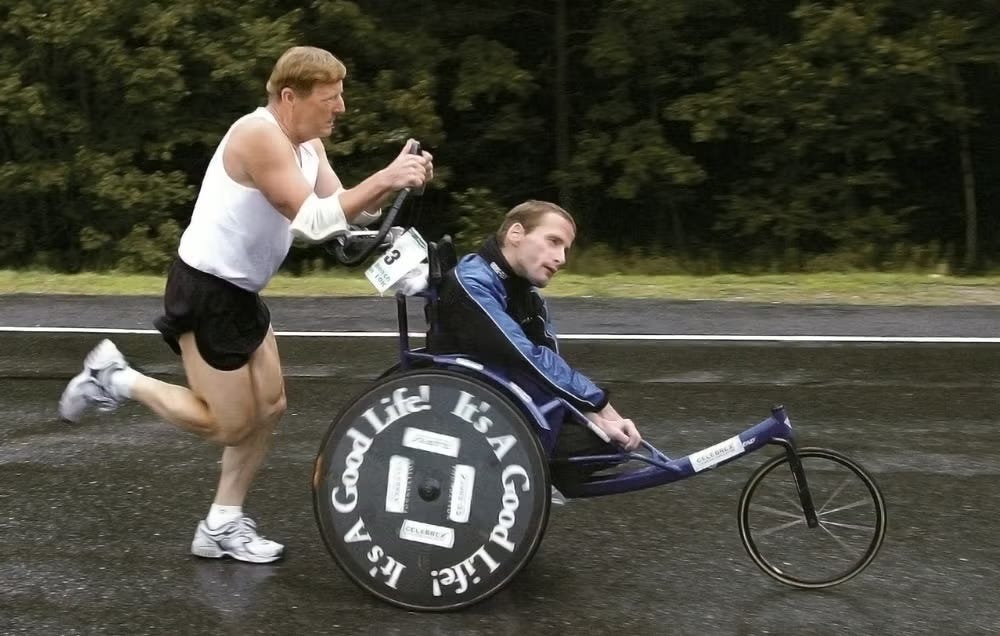
From there, the story grew far beyond one event. Team Hoyt began entering races together and kept showing up year after year. They eventually completed more than a thousand endurance events, including dozens of marathons and hundreds of triathlons.
Their method became iconic: Dick pushed Rick on the run, pulled him in a boat during the swim, and towed him on a bike. Many people watched and assumed the whole story was about a father’s sacrifice. That is true, but it is not the whole truth.
Because the partnership worked both ways.
Dick offered strength and mobility. Rick offered purpose and direction. When quitting would have been the logical option, Rick gave his father a reason to keep going. Over time, Team Hoyt became less about overcoming a condition and more about refusing to let a condition decide who gets included.
“I have a beautiful son and an activity we can do together, despite his disability. It’s been an incredible journey. I’m not a hero. I’m just a father. And all I did was tie on a pair of running shoes and push my son in his wheelchair.”
- Dick Hoyt in his book Devoted (2010)
Rick could not run, bike, or swim independently, yet his desire to participate gave Dick a mission that reshaped both of their lives. What looked like a one-way act of giving became a relationship where each person carried something essential. Dick carried his son through courses and currents. Rick carried the meaning of it all.
The deeper lesson is not about heroic effort alone. It is about inclusion. Dignity is often built when someone is allowed to fully participate, even when they cannot do it alone. That principle shows up everywhere, not just in sports. It shows up in who gets invited into the room, who gets listened to, and who gets supported without being treated as less.
So the story leaves a question we can take into our own lives, whether we are thinking about work, family, or friendships:
Who gives you your “why,” and how are you honoring that gift?
Around us exists a bunch of people who preform miracles, the question is why don’t we?
Everything is possible when you set your mind to your goals