


Hunting season had begun.
In November 1902, Theodore Roosevelt traveled to Mississippi for a bear hunt near Onward, invited by Governor Andrew H. Longino. Roosevelt wanted a fair hunt, but hours passed without success.
Members of the party eventually cornered a black bear, injured it, tied it to a tree, and sent for the president so he could take the shot.
Roosevelt took one look and refused. Killing a restrained animal for sport struck him as unsporting, and he would not take credit for a win that had been manufactured for him.
Accounts from the Theodore Roosevelt Association also note that he ordered the wounded bear to be put down to end its suffering, but he would not treat it like a trophy.
The refusal could have stayed a small, private decision. It did not. The incident reached newspapers, and then it reached the pen of Washington Post cartoonist Clifford Berryman.
On November 16, 1902, Berryman published “Drawing the Line in Mississippi,” depicting Roosevelt sparing a small bear. The image stuck because it captured something clean and memorable: a powerful man choosing restraint when no one could have prevented him from doing otherwise.
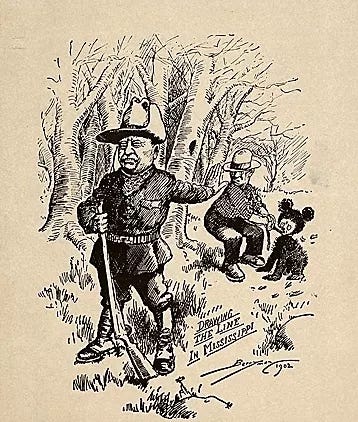
That cartoon made its way to Brooklyn, where candy shop owner Morris Michtom and his wife Rose sewed a stuffed bear and displayed it in their window as “Teddy’s Bear.” Roosevelt reportedly gave permission for his name to be used.
The idea caught on, production followed, and the teddy bear entered the culture as something far bigger than its origin story.
A single decision in the woods passed through other people’s hands and imaginations, and it became an object that has comforted children and adults for generations.
“We have all been delighted with the little bear cartoons.”
- Teddy Roosevelt, after receiving a calendar of Berryman’s cartoons
Roosevelt did not try to turn the moment into a statement. He simply chose not to do something that felt wrong, even though it would have been easy to go along. That is why the story lasts.
People pay attention to the lines we draw, especially when those lines cost us something small like pride, convenience, or social approval.
This is where the ripple begins. Character is contagious. When you refuse the unfair advantage, you teach everyone watching that the shortcut is not normal or necessary. You also give someone else courage to hold their own line later, in a situation you will never see.
The second part is harder to predict. Meaning is often created downstream. Roosevelt’s “no” became a cartoon because an artist noticed it. It became a toy because a couple saw possibility in the image. It became an icon because millions of people kept choosing it as a symbol of comfort.
Roosevelt could not have mapped that chain if he tried, and that is the point. You rarely know which moment will inspire someone else, so it is always worth acting in a way you would be proud to see repeated.
Do the right thing even when it seems small. Someone else might turn it into something big.
So now I ask you:
What is one line you want to be known for not crossing, even when nobody would find out?
Lovely story. Lot to learn from a true man. Every one is watching, if we can give a good example, let’s do it.
There's a lot that resonates with me in this story, great read!